Friday, May 22, 2015

Pentecost : Homily / Sermon

If you love me you will keep my commandments … the Advocate, the Holy Spirit, whom the Father will send in my name, will teach you everything. (John 14:15, 26)

The Death and Resurrection of Jesus - as I guess we all know - happened when Jerusalem was filled with pilgrims who were in the city for the great celebration of the Passover. The crowds gather to cheer Jesus into the city, on what we now call Palm Sunday. Pilgrims were buying and trading in the temple when he turned over the tables. They gathered there to listen to him preach. The Last Supper was a Passover Meal, and St John points out that Jesus sacrifice on the Cross coincided with the slaughter of Lambs in the temple for the Great Feast. When we celebrate Easter in the Mass of the vigil we recall the passover itself and the escape of the Hebrews through the Red Sea, which the Church sees as a foreshadowing of Baptism, our own share in the death and resurrection of Jesus. Indeed this great candle, which stands in pride of place, is the Paschal candle - the Candle of the Pascha, the Passover.

And now seven weeks later, on the 50th day after the Passover, the Jewish people celebrate another festival, the feast of Shavuot. Again the city of Jerusalem is full of pilgrims, pilgrims from all over the known world, the Roman empire. People of many home languages.
Parthians, Medes and Elamites; people from Mesopotamia, Judaea and Cappadocia, Pontus and Asia, Phrygia and Pamphylia, Egypt and the parts of Libya round Cyrene; as well as visitors from Rome – Jews and proselytes alike – Cretans and Arabs. (Acts 2:9-11)

The name Shavuot literally means “Weeks”, “The Feast of Weeks”, though in Greek it was named not after the seven weeks, but the 50 days, Pentecost. It was a festival of the Harvest, the thanksgiving for the Gifts of God, and came to be also for the Jews the day when God’s greatest gift to them was given, the gift of the Law, given to Moses on Mount Sinai.

NewImage

Our Christian feasts are rooted in these Jewish celebrations, and this year Jews and Christians are celebrating these connected feasts at about the same time. For us Christians, these festivals have been transformed by Christ - his Passover from death to eternal life, and his greatest Gift, the Gift of the Holy Spirit at Pentecost.

Remembering this connection, this origin, reminds us of what we shares with the chosen people, and also how Christ has fulfilled and transformed their heritage. For the Jews the Great Gift it the Law, set out in the five books of Law in what we call the Old Testament, and subject to centuries of interpretation: for us it is the Holy Spirit, who transforms our hearts, sustains us through the sacramentsm, and establishes, sustains and protects the Church.

The two feasts, the two Pentecosts may seem to us to present a clear contrast, between a document of Law, and a motive power in our hearts. But we must be careful. Both feasts, both Gifts, are beyond ourselves and remind us that God requires our submission our obedience and our love. Service of him is to accept and adopt his will. To follow his Law, to be guided by his Spirit. In neither case does the Gift make us our own source of authority and truth, but rather reminds us that we must follow him, for only in this way can we be led into all truth.

It is not that the Gift of the Spirit enables us to overrule the Law with our own whims, wishes and wilfulness - but by the Gift of the Spirit, God writes the Law into our hearts. And we must read his will, accept the authority of his Word and his Church. And follow him. And serve him. And call others to the same truth.

 

Friday, April 03, 2015

Good Friday

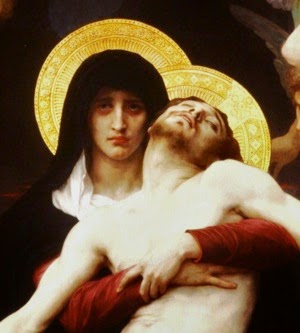
William Adolphe Bouguereau 1825 1905 Pieta 1876Christ has died.


The head which was was nursed at his mother’s breast, 

The head which was suffused with light at his Transfiguration

The head which was crowned with thorns, 

is bruised, bloodied and lifeless now.


The eyes which looked from the manger into his mother’s loving gaze

The eyes which looked with compassion on the rich young man

The eyes which wept over Jerusalem

are now cold and empty.


The ears which heard the song of the angels

The ears which heard the voice say from heaven “This is my beloved Son”

The ears which heard the crowd cry out “Crucify him”

now hear none of the sobs made over his body


The lips which said to the paralysed man “your sins are forgiven you”

The lips which told the parables of the Good Samaritan and the Prodigal Son

The lips which said “I am the resurrection and the life”

now, drained of colour, smile and speak no longer.


The hands which stilled the storm

The hands which blessed the children

The hands which healed the blind, deaf and lame

now rest motionless, pierced and lacerated.


The feet which climbed the mountain to pray

The feet which walked on the water

The feet which were washed with the tears of the penitent woman

are now twisted, maimed and mutilated.


The heart which beat for love of sinners

The heart which longs for the peace of the world

The heart which beats with our hearts

beats no more.


Christ has died. 

He is laid in the tomb. 

The Great Silence begins. 

But the story has just begun.

Friday, March 20, 2015

Fifth Sunday of Lent : Homily / Sermon

Unless a grain of wheat falls to the ground and dies, it remains a single grain. (John 12:24) 

Did you see the eclipse yesterday? Well of course, you shouldn’t have looked at it directly … But at least for us, Unlike most of the country, we did have sight of the sun through the clouds. 

It was brief, and perhaps not so very different from an overcast day, but the time when the moon moved over the face of the sun here led to an eerie light, unlike anything we normally see. 

An eclipse is one of those events and features of nature that is now well understood and so well documented, and yet still takes us by surprise and makes us amazed. Perhaps, unlike the ancients, we do not see it as an omen of bad fortune, but are nevertheless surprised and awed by it - however predictable it may be. 

The dimming and relighting of the sun in a way mirrors what is happening in this very season of Lent. It is time in which we are aware of an approaching darkness as Jesus draws to Jerusalem, and we are await the predicted doom. 

Yet is is also a time when we move, bit by bit, from the darkness of winter to the brightness of spring. 

As we entered January, and the season of festivities is set behind us winter becomes a dour and dark, a cold and cheerless time. The hours of daylight are short, and overcast and gloomy. The trees stand bare and lifeless. And the mood of the earth is one that we too might share. February, when it comes is a miserable time. No wonder it is then when Ash Wednesday usually falls. 

And then March arrives, and moves towards April. Still cold, and often windy, though the sun may shine. In the midst of showers there is bright sunlight. Shoots emerge from the ground. Leaves form on the trees, and the grayscale around us becomes punctuated with colour: a little green, the yellow of daffodils, the pinks of early blossoms. 

As, during Lent, we do without this or that, the loss of colour and warmth which has been forced upon us begins to draw back, like the Sun remerging from its eclipse. Sunlight, warmth, colour, and the freshness of the spring breezes enlivens us again.

Here in nature - even in the nature of our lit streets and our centrally heated homes - here in nature is a vivid parable of the mystery of our faith. 

Drabness gives way to colour, darkness recedes in the sunlight, sorrow surrenders to joy and death gives way to life. 

Unless a grain of wheat falls to the ground and dies, it remains a single grain, but if it dies, it yields a rich harvest. 

There is no gain without pain, no light without shadow. We must travel through darkness to light, through sacrifice to reward. We must give in order to receive. We must surrender our lives in order to gain them. 

In this final fortnight of Lent - what used to be called Passiontide - this is the overwhelming message, written into creation itself, fulfilled in the life, death and resurrection of Christ and shared in our own lives: it is death which leads to fulness of life, and as we share in His death, so He gives us His life.