
Work for the food that endures to eternal life (John 6:27)
Do you believe in mind over matter?
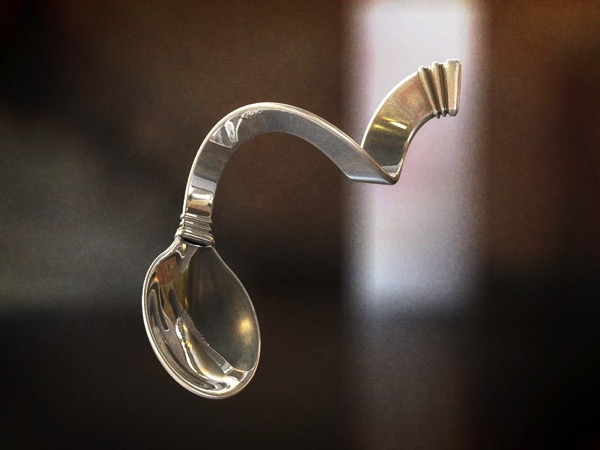
It is certainly true that the mind can have great power over the body. (It’s not just a matter of spoon bending - which may well be a conjurer's illusion). There are those who can will themselves to walk barefoot over hot coals, apparently without pain or injury. Under hypnosis people can be encouraged to do things they would never normally be able to achieve. And there is much evidence that when sick people are given placebos - tablets that they believe to have medicinal content, but which have none - they may nevertheless recover just as if they have been given the real drug. It is not just a matter of will-power and determination, the mind is even more powerful than that.
And so people sometimes suppose that the mind, or the “spirit” as we might say, is always greater, more powerful, more real than matter, body, physical reality. They suggest that if you just pull yourself together, or meditate, or pray hard enough, then all your troubles and even illnesses will go away … And (following this absurd point of view) … If your troubles continue, then your determination, commitment, resolve and indeed faith must have failed in some way. Isn’t it said “faith can move mountains”? If so - this idea goes - I only have to pray hard enough and all my wishes will be be fulfilled. And if they aren’t - then hasn’t my faith has failed …
Well. The mind is powerful. And prayer can help us achieve very much.
But no one is all mind, no one just body, both are part of one another - and we know only too well that if we are ill, then it affects both mind and body. Toothache makes us bad tempered - not even the greatest saint can get away from that.
So we need to be careful. This false division, between mind and body, can affect how we think of our spiritual life.
It is a common mistake, that both religious and non-religious people make, to separate out the spiritual and the physical.
On the one hand, religious people may think of the spirit as something very distinct from our physical existence. In this idea we hunger or suffer in the body but the spirit is free from need and free from pain, it is just pure thought, pure personality, free from the chains of physical life. Don’t be concerned about suffering on earth - so this viewpoint supposes - your reward will be great in heaven.
And the reverse of this particular coin is that the physical world is complete in itself. It has no need of “spirit”, or a “next” life. This view gives us the idea that science can answer every question and solve every problem. The physical world - so it seems - can answer its own questions without - as the atheists put it - resorting to our “imaginary friends”.
These are very commonly held ideas. And though they lead to opposite points of view, fundamentally they share the same assumptions. And they are both wrong.
When Jesus explains the spirit he always describes it in very solid, very physical terms. It is the food which endures for ever. It is the satisfying of hunger and the quenching of thirst. It is the bread which comes down from heaven.
It is the spirit which fills the physical with life and truth and purpose, and eternity. Without the spirit, matter has no purpose, no meaning. It is something to be used. Something to be discarded. Something of no value. With the Spirit, matter becomes something we can use in a right or a wrong way. And how we use the physical world, nature, is a moral issue - as Pope Francis has made very clear. The beauty of nature, the diversity of species, the resources of the planet are as much moral issues as compassion and social justice.
Spirit and matter, soul and body are not two separate things best kept apart. They are one: created by God, redeemed by him in Christ, the Word made flesh, the bread of heaven.
Lord, give us that bread always! (John 6:34)

