Showing posts with label faith. Show all posts

Thursday, July 30, 2015

18th Sunday of the Year (B) : Homily / Sermon

Work for the food that endures to eternal life (John 6:27)

Do you believe in mind over matter?
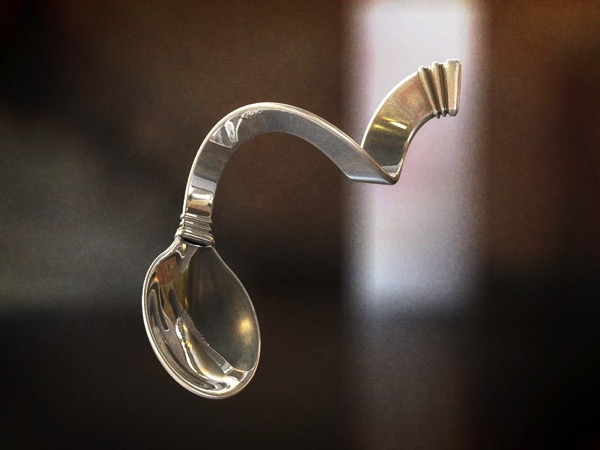
Spoon Bending - an example of mind over matter?

It is certainly true that the mind can have great power over the body. (It’s not just a matter of spoon bending - which may well be a conjurer's illusion). There are those who can will themselves to walk barefoot over hot coals, apparently without pain or injury. Under hypnosis people can be encouraged to do things they would never normally be able to achieve. And there is much evidence that when sick people are given placebos - tablets that they believe to have medicinal content, but which have none - they may nevertheless recover just as if they have been given the real drug. It is not just a matter of will-power and determination, the mind is even more powerful than that.

And so people sometimes suppose that the mind, or the “spirit” as we might say, is always greater, more powerful, more real than matter, body, physical reality. They suggest that if you just pull yourself together, or meditate, or pray hard enough, then all your troubles and even illnesses will go away … And (following this absurd point of view) … If your troubles continue, then your determination, commitment, resolve and indeed faith must have failed in some way. Isn’t it said “faith can move mountains”? If so - this idea goes - I only have to pray hard enough and all my wishes will be be fulfilled. And if they aren’t - then hasn’t my faith has failed …

Well. The mind is powerful. And prayer can help us achieve very much.

But no one is all mind, no one just body, both are part of one another - and we know only too well that if we are ill, then it affects both mind and body. Toothache makes us bad tempered - not even the greatest saint can get away from that.
So we need to be careful. This false division, between mind and body, can affect how we think of our spiritual life.

It is a common mistake, that both religious and non-religious people make, to separate out the spiritual and the physical.

On the one hand, religious people may think of the spirit as something very distinct from our physical existence. In this idea we hunger or suffer in the body but the spirit is free from need and free from pain, it is just pure thought, pure personality, free from the chains of physical life. Don’t be concerned about suffering on earth - so this viewpoint supposes - your reward will be great in heaven.

And the reverse of this particular coin is that the physical world is complete in itself. It has no need of “spirit”, or a “next” life. This view gives us the idea that science can answer every question and solve every problem. The physical world - so it seems - can answer its own questions without - as the atheists put it - resorting to our “imaginary friends”.
These are very commonly held ideas. And though they lead to opposite points of view, fundamentally they share the same assumptions. And they are both wrong.

When Jesus explains the spirit he always describes it in very solid, very physical terms. It is the food which endures for ever. It is the satisfying of hunger and the quenching of thirst. It is the bread which comes down from heaven.

It is the spirit which fills the physical with life and truth and purpose, and eternity. Without the spirit, matter has no purpose, no meaning. It is something to be used. Something to be discarded. Something of no value. With the Spirit, matter becomes something we can use in a right or a wrong way. And how we use the physical world, nature, is a moral issue - as Pope Francis has made very clear. The beauty of nature, the diversity of species, the resources of the planet are as much moral issues as compassion and social justice. 

Spirit and matter, soul and body are not two separate things best kept apart. They are one: created by God, redeemed by him in Christ, the Word made flesh, the bread of heaven.

Lord, give us that bread always! (John 6:34)

Saturday, December 31, 2011

Mary, Mother of God: Homily / Sermon

Homily for the Solemnity of Mary, Mother of God

As for Mary, she treasured all these things and pondered them in her heart. (Luke 2:19)

NewImage

These few words, which occur on a couple of occasions in Luke's Gospel, have had a far reaching impact. They are words which struck Blessed John Henry Newman too, and he preached a famous homily on them, and they inspired him to write one of  his best known works, the Essay on the Development of Christian Doctrine.

They speak to us about the Heart of Mary, the Immaculate Heart. A phrase not used in Scripture itself, but a phrase which reveals much of what Scripture teaches. They tell us so much not only about Mary, but about our own understanding of God.

In telling us that Mary treasures and ponders these words, St Luke is telling us that she said little, but thought much. Unlike the time when the Angel visited her, she does not ask questions, she does not challenge the message given to her. That was her moment of faith, when she accepted God's will for her. Now she listens, treasures, ponders. She lets the message unfold in all its detail. She reflects and prays. She has already accepted God's will, and now, bit by bit it becomes clear to her just precisely what that means.

And that is how faith works. When we commit ourselves to faith in God, belief in his coming in the flesh, his resurrection, in the Trinity - it does not mean that we instantly and fully understand all these things. The commitment of the heart always comes ahead of the understanding of the mind. Faith leads to understanding, commitment comes before knowledge, for it is the heart that enlivens the mind.

If there are aspects of the faith we do not understand, doctrines and dogmas which puzzle and confuse us, teachings which are hard to listen to or explain, we should never feel inadequate or allow this to undermine our faith, but turn rather in prayer to this simple woman, who listened, treasured and pondered; who served her Son; and who is Mother of Faith, Immaculate Heart, Mother of God.

Saturday, May 21, 2011

Easter 5: Homily / Sermon


Do not let your hearts be troubled. Trust in God still, and trust in me. (John 14:1)

Stephen Hawking 008In a recent talk, the famous physicist Stephen Hawking said that heaven ‘is just a fairy story for people afraid of the dark’.

It’s just one statement of course, which is part of a much bigger talk about a wide range of things. And it’s not a new idea or point of view - non-believers have being saying similar things for centuries.

But it has always struck me as an odd idea, and one strange for a scientist to hold, as it seems to fly in the face of evidence.

You see it is simply not true that people of faith are those who are afraid of death (that’s what he is really talking about) and that people who have no faith are not. You don’t have to be a believer to see that just isn’t the case.

Look at the lives of the martyrs, who in courage and faith are willing to surrender their lives, praying for their persecutors and submitting to death. Look at the lives of other saints, good and faithful servants of God, who give themselves in service of others and approach death not with fear but with hope and joy. And look at the words of Christ, who invites us to cast fear and doubt aside and embrace the love of God: “Do not let your hearts be troubled”, he says. “Trust in God still, and trust in me”.

And I am reminded that this Gospel reading is read so often at Funeral Masses and Funeral Services. It is a time when, as a priest, I see most clearly how people deal with grief, loss, and the reality of death. And I can tell you this, the greater the faith of the one who has died and of the people who mourn him, the more serene, the more positive, the more realistic the experience of grieving - and the weaker the grasp of faith which the bereaved have, the harder the whole experience of loss is, the greater the pain, the more acute the suffering. It is those who have faith who do not shirk from words like death - and those who struggle with faith who avoid the word, with talk about ‘passing away’ ‘moving over’ ‘going to his rest’.

And I can truly say that some of the most inspiring acts of worship I have ever been part of, have been the funerals of faithful Christians. Now none of this is to say, of course, that believers do not grieve. Of course we do. Or that we are not aware of the reality of death. Of course we are. We can face the pain of loss and the reality of death because we have a hope.

If Stephen Hawking, and those who agree with him, think it is praiseworthy and honest to remain in the dark, then that is their choice.


But its much better to come out into the light.


Friday, March 04, 2011

Homily / Sermon for the 9th Sunday of the Year

Everyone who listens to these words of mine and acts on them will be like a sensible man who built his house on rock. (Matthew 7:24)

IMG_6136

Jesus parables are often a challenge to me. He speaks from the experience of people around him, so they are often about agriculture - like the parable of the sower - or occasionally from his own profession - the building trade.

I’m afraid I am a very poor gardener - not in the sense that I can’t get things to grow - but they all grow too fast and too many of them in the wrong places. It’s shameful really as it was my grandfather’s profession and as a little boy I spent many happy hours helping him in his greenhouses.

And then when it comes to DIY  … well, I can change a light bulb, and I am safest as far as possible away from any other practical project.

So how can I approach the parables? Well thankfully you do not need to be skilled in either area to understand them. No technical terms, notice, in this story about the houses, but they do have both a practical and a spiritual sense.

The practical meaning is pretty obvious to all. The quickest way to achieve something is not necessarily the best. The house built on sand was built much more quickly and more easily. It would have looked just as good - perhaps even better - than the house on rock. But it had a fatal flaw.

And there is also a spiritual meaning. Faith is a hard road. It may not make life easier. There are those who seem to have more fun, less anxiety, are richer, healthier. Those who follow the faith may struggle forcing foundations into the rock. It may take time to see results. There may be hardship, sorrow, crises of conscience along the way. Faith does not rescue us from suffering, but it does give us a hope. The house on sand is beautiful till the storms come. The storms batter the house on rock too, but it has the foundations to stand firm.