Monday, February 19, 2018

Lent 2 (B) Sacrifice of Isaac | Homily / Sermon

“I will shower blessings on you, I will make your descendants as many as the stars of heaven and the grains of sand on the seashore” (Genesis 22:17)
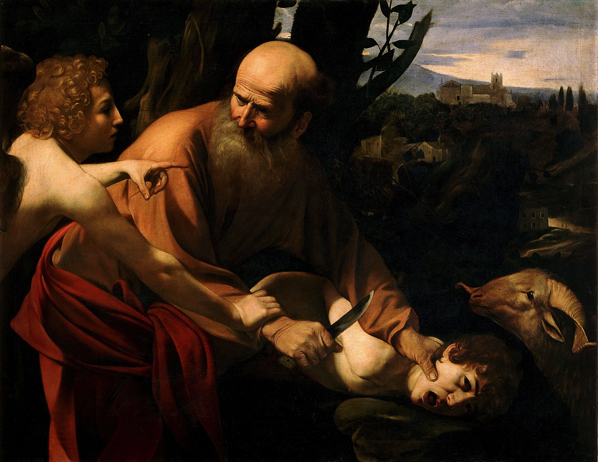
NewImageLast week it was Noah’s Ark, and this week the story of the sacrifice of Isaac. Or not so much the sacrifice, but the attempted sacrifice. The Old Testament can certainly challenge our understanding!

On the face of it, this is a horrific story. God tells Abraham to sacrifice his son, and Abraham, out of blind faith, almost carries out the order. Only at the last minute does he hold his hand. Is this the sort of thing God does? Well, we would find it hard to say yes.

But then we must look at two stories together.

The Gospel reading tells us of another mountain. And another Son. And this time the Father is God himself. On the first mountain faith is clear, but the will of God is not. On the second mountain the voice of God speaks clearly and his Glory is revealed.

In the first reading Abraham is blessed not because of the action he did not carry out, but because of his utter devotion to God. In the ancient world, even more than today, family was everything. The clan, kith and kin, the succession, this was at the heart of the fabric of society. Abraham realised that faith in God is greater even than this.

And in the Gospel we hear that the sacrifice is not the sacrifice of an unwilling son, but the gift of God himself, in the Son. Just as in the Old Testament, God replaces the brutality of human sacrifice with the sacrifice of a Ram, so in Christ it is the Lamb of God the takes our sins upon himself.

Sacrifice is, at the end of it all, not about violence, but about love. It is not about taking a life, but about giving life. It is not about blind faith, but about the hope of resurrection, the resurrection of the One clearly seen in all his glory.

Saturday, February 10, 2018

Lent 1 (B) Noah's Ark : Homily / Sermon

God spoke to Noah and his sons, ‘See, I establish my Covenant with you. (Genesis 9:8-15)

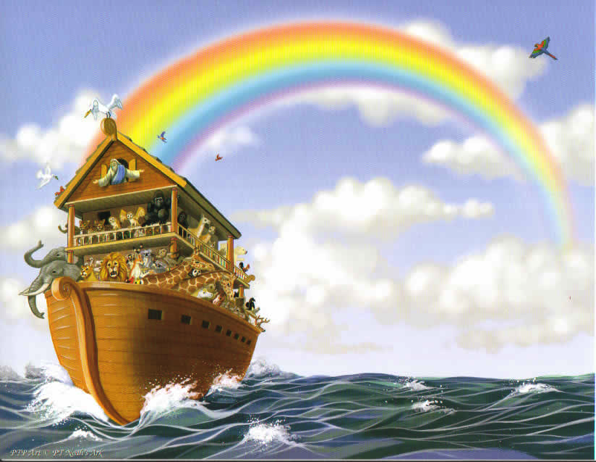
NewImageIn the first five Sundays of Lent in Year B we are presented with an introduction to the Old Testament. We begin with the story of the covenant of God with Noah, and a reminder of the sign of the covenant - the rainbow. How can we understand this story, and what on earth has it got to do with Lent, with Jesus’ temptation in the desert?

Some people will look at this story and try to find the historical evidence to support it, and some of that is intriguing: in many cultures there are stories of great floods, and some archeologists have even tried to find evidence of the Ark, and the mountain on which it landed.

At the other extreme, there are those who reject the story out of hand. It is just a tale from primitive people, they say, to explain the rainbow, and a way to explain the presence of some beauty in the midst of much danger. Such people would also point out that the destruction of men, women and children alike, cities and civilisations, is very unworthy of a God of love.

For the Church though, neither of these paths are satisfactory. The search for historical detail will tell us little of use, and the complete rejection of the story fails to take it seriously at all. Even if one view or the other is true, neither tells us what the story actually means.

No, from ancient times, Christian writers have pointed out that it is the symbolism of the story which gives its underlying message, and when we consider it in this way, it’s really meaning opens us before us, like the blooming of a flower.

And so It is a wonderful story with which to begin Lent, and throws great light on the story of Jesus’ temptation in the desert.

It sets before us the Covenant between God and the entire people of the earth. The pledge, promise, commitment of love which God makes to the humanity - despite our faithlessness and our failings, despite our suffering and our sin.

Here - just as Jesus prepares to embarks upon his ministry - his teaching, his healing, his suffering and his sacrifice - we have an account of the Ark and the aftermath. It is a tale full of sin and salvation, of destruction and compassion, of faith and hope.

It meets us on the swell of water, which washes away so much, and a small boat which saves God’s wonderful creation.
We hear echoes of the salvation of a nation through the waters of the Red Sea; it points forward to the stilling of the storm by Jesus, and his walking on the water. In the salvation of Noah and his family from destruction, there are hints already of the death and resurrection of Him who waits in the wilderness. This account, in the earliest pages of the Old Testament, prefigures already the Christian journey of baptism through water, and of the promise of eternal life.

And the 40 days on the boat, are reflected to us in the 40 days of Christ in the wilderness, and we share with them in our 40 days of Lent.

They are all a time of journeying from sin, a time of patient hope, a time of promise, a time of trial, and a time which shines brightly over us, in the rainbow, in the promise of redemption.

Saturday, January 20, 2018

3rd Sunday in Ordinary Time : Homily / Sermon

‘Follow me and I will make you into fishers of men.’ (Mark 1:17)

NewImageToday's Gospel presents us with a simple story - the call of the disciples Peter and Andrew, and James and John. Two sets of brothers. Four manual labourers, four workmen. Four people who were no doubt skilled at their work, but probably otherwise uneducated. And as we know from elsewhere, they were direct, straightforward, and sometimes hotheaded men.

And Jesus invites them: not to fame or riches. He promises not worldly status or even an easy life. He does even invite them to join a cosy community isolated from the troubles of them world.
He calls them to leave the work they know, and embark upon something they can hardly begin to understand. The only hint or inkling they can have is that in calling these two pairs of brothers, he is saying, “come and do what I do, come and call others to follow - be fishers of men, callers of humanity, gatherers of peoples”.

And so - at the very start, at the first assembling of his followers, Jesus is preparing for a time when they must take the lead. He is assembling those who must follow him in order to gather others. He is already anticipating a time when they must do this without his immediate presence - at least not present in the way he was on that day by the lake.

At the moment of the call of the very first of the apostles, he is preparing them already for his death and resurrection.

He is assembling a community, a Church, to continue his work of preaching, teaching, comforting and calling. A Church that is set to grow because its purpose is to drag others into its nets, to call others into its fellowship, to proclaim and message of hope and welcome humanity into God's love.

The Church we he forms from these few first followers becomes his body, now alive in the world.
And so he is calling us to continue his work of healing, or praying, of teaching, of loving.

It could not be expressed more beautifully than it is in words attributed to St Teresa of Avila.

Christ has no body now on earth but yours,
no hands but yours, no feet but yours,
Yours are the eyes with which he looks with Compassion on this world,
Yours are the feet with which he walks to do good,
Yours are the hands, by which he gives his blessing.

Prayer of St Teresa of Avila (1515–1582)