Tuesday, October 01, 2013

27th Sunday in Ordinary Time : Homily / Sermon

The apostles said to the Lord "Lord, increase our faith". (Luke 17:5)
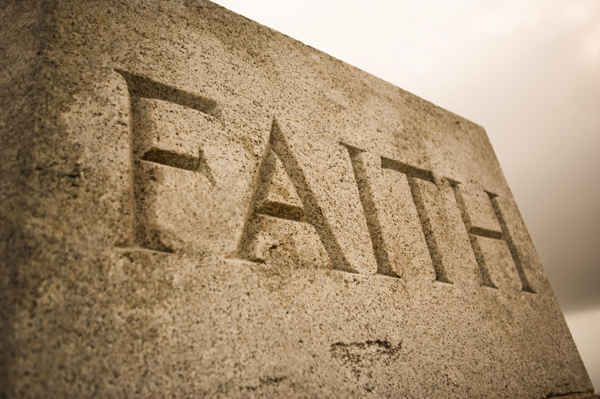
 

NewImage

Today's Gospel looks as though it's in two parts, with two differing messages. Firstly, the disciples ask Jesus to increase their faith. In the second part, he speaks about the importance of being a good and faithful servant. On first reading they might appear disconnected. 


But are they? 


Faith, not surprisingly, is a frequent theme in Jesus' teaching. He often rebukes the disciples for their lack of faith. At the stilling of the storm, for example, when they wake him in the boat - "O men of little faith" he says. He remarks on their lack of faith too, when, after the transfiguration unable to heal the epileptic boy - and then, the father of the boy says, "I have faith, help me where faith falls short!"


In hearing such teaching, we, like those in the story, might feel rather inadequate. How can we ever have enough faith? What can we do to be more faithful? 


But here, we have words of great encouragement. 


Firstly, the apostles see one thing very clearly.  "Lord, increase our faith", they say. For their faith to increase - well that must be an act, or gift, or rather grace of God, not something they can do simply by their own efforts. We might think that if only we believed more, prayed harder, said more rosaries or attended more masses, then we would have more faith - but no. We can stand in the way of faith, but fundamentally faith is a gift of God, not an achievement of humanity. 


Secondly, we should not worry about faith, as if it could be measured, weighed, valued. We, like the apostles, might feel we have little faith, but - Jesus says, even the tiniest amount of faith, faith as tiny as the mustard seed, can achieve extra-ordinary things. "You've got only a little faith?" Jesus seems to say, "You'll be amazed what it can do!  


And thirdly, and this is where the two parts of today's Gospel are joined together - living in faith is not about being impressive, or important, super holy. How do we live and keep the faith? The answer is beautiful in all its simplicity. It doesn't require great knowledge or understanding or extra-ordinarily impressive holiness. Just this - Be a good and faithful servant. Do your duty. Perform your service of God. Do not feel inferior or superior. Just do what you know to be right. Offer him your worship and show love and compassion to all people. Love God and love your neighbour. No more and no less is required. 


"We are merely servants, we have done no more than our duty" the Gospel says. This is sanctity. This is holiness. This is faith!


Saturday, September 28, 2013

26th Sunday in Ordinary Time : Homily / Sermon

If they will not listen either to Moses or the prophets, they will not convinced even if someone should rise from the dead. (Luke 16:31)


NewImage

The rich man - who is not given a name, notice - wants Abraham to send Lazarus to warn his brothers that they must change their way of life. Yet, Jesus says, there is no point - they already have all the warning they need. Why should a great miracle make a difference? 

There's an important and very broad point being made here, one which we here several times in the teaching of Jesus and elsewhere in the New Testament, and it is this: all this has been foretold, all this is plainly to be seen in the teaching of Moses and the prophets (what we Christians call 'the Old Testament'), no one should be confused or surprised. 

Yet they are. Frequently, Jesus chides his disciples for their failure to understand. After the Crucifixion, the disciples on the road to Emmaus need the prophecies explained to them by the risen Christ. From the day of Pentecost onwards, Peter and other other apostles must explain in their preaching how the coming, suffering and resurrection of Jesus perfectly fulfil what was promised. And St Paul, again and again, argues and explains the old scriptures to show how they point to the new, the Christ, the one who suffered and is risen. 

And the point, perhaps is this. People ask for proof. Prove God exists they say. Prove that God is love. Prove that prayer is not a waste of time. Prove that the world is created and didn't just come into existence as a sort of accident or co-incidence. Give us the evidence. 

And the proof is already there. We can't show it to them - because they can already see it. We can't convince them of it - because they are already ignoring it. They see, and refuse to believe their own eyes. 

The beauty of the world. The wonder of the planets and stars. The miracle of life. The compassion and generosity of humanity. The conviction and self sacrifice of the saints. Its all there. It is before them. 

It is not the evidence that is lacking, but the eyes that are closed, and ears that refuse to hear.

Friday, September 06, 2013

23rd Sunday in Ordinary Time : Homily / Sermon

None of you can be my disciple unless he gives up all his possessions. (Luke 14:33)

NewImage

There have been many Christians, throughout the history of the Church, who have taken Jesus’ teaching here very literally.

The first Christian community at Jerusalem, seems to have shared all things in common. St Anthony of Egypt, and the monks of the early Church, gave up their many possessions and went to live in the desert. About 1,000 year later, St Francis of Assisi embraced “Lady Poverty” and forswore the wealth of his merchant father and lived literally from hand to mouth, dressed only in the simplest of habits. And many many others, in the religious orders have given up lives of comfort to follow Christ.

But in general most Christians do not, and did not live without possessions, and Jesus did not expect them to. He told the rich young man to give up his possessions, but not Nicodemus or Joseph of Arimathea who gave Jesus his tomb. The apostles appointed the first deacons to manage the finances of the Church, and even in the most difficult times the Church held property, and eventually houses and churches. Like any other organisation, the Church has needed finances to fund its activity, beautify its worship and feed its workers.

But necessary though this all is, the Church must never lose sight of the fundamental teaching of Jesus, and the challenges he lays before us all: where does our attachment lie? What is most important to us all?

My favourite story in this regard is told of the deacon Laurence, who was commanded by the Roman Magistrate to bring before the court all the riches of the Church (then, as now, the opponents of the Church like to think that it is very rich). He was given a deadline. The Magistrate was told that Laurence had indeed brought to the court the Church’s riches and laid them on the steps to the courthouse. The Magistrate came out of the court to see the sick, the disabled, the poor, the destitute, orphans and widows sitting on the steps.

“Behold!” said St Laurence. “Here are the treasures of the Church!”